

It’s barely late afternoon and the sky is already turning dark. You’re not imagining it. Around 21 December, the Northern Hemisphere reaches its shortest day of the year, and for thousands of years people from Iran to China to the British Isles have marked the moment with the same simple message: happy winter solstice.
This guide covers what the winter solstice is, when it falls in 2026, why it happens, how cultures around the world celebrate it, what to write in a greeting, and easy ways to mark the day yourself. A full FAQ and quick Q&A are at the end.
Quick Answer: What Is the Winter Solstice?
The winter solstice is the day with the fewest hours of daylight and the longest night of the year in a hemisphere. In the Northern Hemisphere it falls on 21 or 22 December. In 2026 it arrives on 21 December, at about 20:50 UTC. After it, the days slowly get longer. “Happy winter solstice” is the traditional greeting for the day.
Key Takeaways
- The winter solstice is an astronomical event, not a made-up holiday. It happens at one exact moment, the same instant everywhere on Earth.
- It’s caused by Earth’s axial tilt of about 23.4 degrees, not by Earth being closer to or farther from the Sun.
- It marks the start of astronomical winter in the Northern Hemisphere.
- Cultures worldwide celebrate it as a turning point from darkness back toward light.
- The Southern Hemisphere has its winter solstice in June, when the north has its summer solstice.
What Does “Winter Solstice” Actually Mean?
The word comes from Latin: sol means “sun” and sistere means “to stand still.” Ancient observers noticed that around this time the Sun’s rising and setting points seemed to pause on the horizon before slowly moving back the other way. The word captures that feeling of the Sun standing still for a moment.
Astronomers and agencies like NASA often call it the December solstice, which avoids confusion because it’s a winter event in the north and a summer event in the south. It’s also called the midwinter solstice, and in casual speech simply “the shortest day” or “the longest night.”
When Is the Winter Solstice in 2026?
The Northern Hemisphere winter solstice in 2026 falls on Monday, 21 December, at around 20:50 UTC. The exact instant is the same everywhere, but your local date and clock time depend on your time zone.
| Region | Approximate local time of the 2026 solstice |
|---|---|
| UTC / GMT | 21 December, ~20:50 |
| US Eastern | 21 December, ~3:50 p.m. |
| US Pacific | 21 December, ~12:50 p.m. |
| Pakistan (PKT) | 22 December, ~1:50 a.m. |
| India (IST) | 22 December, ~2:20 a.m. |
Notice that for Pakistan and India, the solstice moment lands in the early hours of 22 December, even though the shortest daylight hours are experienced on 21 December. Time zones can shift the calendar date, so always check a source such as NASA or the U.S. Naval Observatory if you need the minute-exact time.
The date can vary too. Because the calendar year and the astronomical year don’t match perfectly, the solstice usually falls on 21 or 22 December, and rarely on 20 or 23 December.
Why Does the Winter Solstice Happen?
Here’s the part that surprises people: it has nothing to do with distance from the Sun.
Earth spins on an axis that’s tilted about 23.4 degrees relative to its orbit. That tilt stays pointed in roughly the same direction while we travel around the Sun. So during part of the year, the Northern Hemisphere leans away from the Sun, and during the opposite part, it leans toward it.
At the December solstice, the north is tilted as far from the Sun as it ever gets. Sunlight hits the Northern Hemisphere at a low angle, so the light is spread thinner (giving less warmth). The Sun also takes a short, low arc across the sky, which means fewer hours of daylight.
Ironically, Earth is actually closest to the Sun in early January, at about 147 million kilometres. Seasons come from tilt, not distance. If distance were the cause, the whole planet would have winter and summer at the same time. Instead, when it’s winter in Karachi, it’s summer in Sydney.
What Happens to the Sun on This Day?
- The Sun reaches its southernmost point in the sky.
- At noon it’s directly overhead along the Tropic of Capricorn, about 23.4 degrees south of the equator.
- Midday shadows in the north are the longest of the year.
- Inside the Arctic Circle, the Sun doesn’t rise at all (polar night), while inside the Antarctic Circle it never sets.
Is the Winter Solstice the Earliest Sunset of the Year?
Not quite, and this trips up a lot of people. In much of the Northern Hemisphere, the earliest sunset happens in early to mid December, before the solstice. The latest sunrise doesn’t arrive until early January, after it.
The reason is a small mismatch between clock time and “sun time,” caused by Earth’s tilted axis and its slightly oval orbit. The solstice is still the day with the shortest total stretch of daylight, but the sunrise and sunset times don’t hit their extremes on exactly the same day. It’s a fun fact to share at the dinner table.
How Much Daylight Do You Get on the Winter Solstice?
It depends entirely on latitude. The farther north you live, the shorter the day.
In Pakistan, the shortest day brings roughly ten hours of daylight in Lahore and around ten and a half in Karachi. In northern Europe, cities can get only six or seven hours, and in Arctic regions there’s none. Near the equator, day length barely changes across the year.
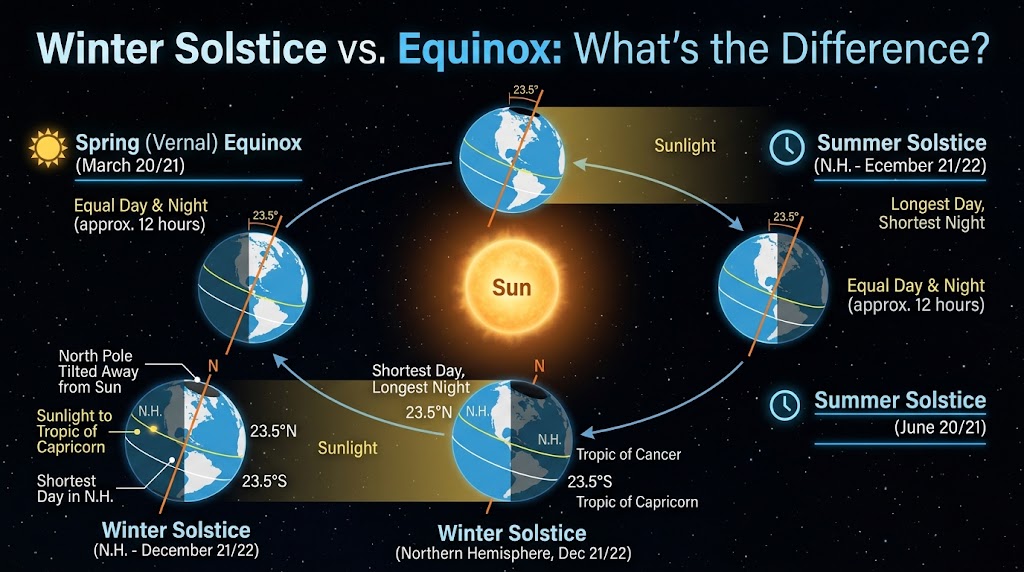
Winter Solstice vs. Equinox: What’s the Difference?
| Solstice | Equinox | |
|---|---|---|
| When | December and June | March and September |
| Daylight | Extreme (shortest or longest day) | Nearly equal day and night |
| Sun’s position | Farthest north or south | Directly above the equator |
| Season marker | Start of winter or summer | Start of spring or autumn |
After the December solstice, the next milestone is the March equinox, around 20 March 2027, which marks the start of astronomical spring in the north.
Winter Solstice vs. the First Day of Winter
There are two ways to define winter. Astronomical winter begins on the solstice, around 21 December. Meteorological winter is simpler: meteorologists start it on 1 December to keep whole months for record-keeping. Both are valid; they just answer different questions.
The Ancient History of the Winter Solstice
People tracked this day long before written calendars, because knowing when the light would return mattered for farming, food storage, and survival.
Stonehenge, England. Many archaeologists believe the monument’s main axis lines up with the midwinter sunset, and today thousands gather there each December to watch it.
Newgrange, Ireland. This passage tomb is over 5,000 years old, older than Stonehenge and the Egyptian pyramids. A special opening above the entrance lets the rising Sun light up the inner chamber for roughly 17 minutes around the solstice.
Ancient Rome. Romans celebrated Saturnalia in mid to late December with feasts, gift-giving, and a relaxed break from normal social rules.
Northern Europe. Germanic and Norse peoples held Yule, with fires, evergreens, and shared meals. The Yule log tradition comes from this era.
The message across all of them is remarkably consistent: the darkest point has passed, and the light is coming back.
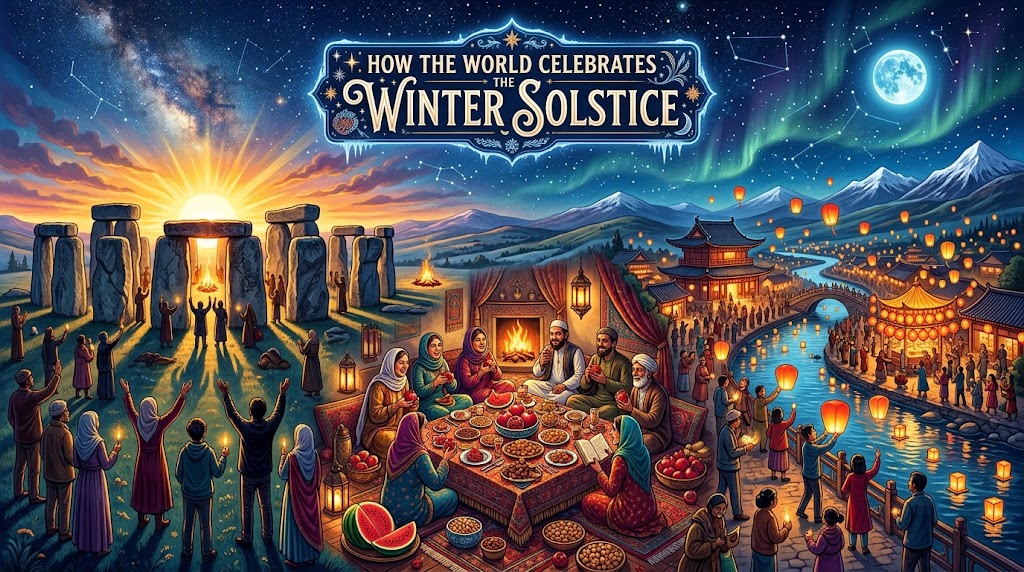
How the World Celebrates the Winter Solstice
| Tradition | Where | How it’s marked |
|---|---|---|
| Yalda / Shab-e Yalda | Iran, Afghanistan, Tajikistan and Persian-speaking communities | Families stay up late, eat pomegranates, watermelon and nuts, and read poetry |
| Dongzhi Festival | China and East Asia | Family reunions; tangyuan (sweet rice balls) in the south, dumplings in the north |
| Toji | Japan | Soaking in a hot bath with yuzu citrus and eating pumpkin for good health |
| Yule | Northern Europe / modern Pagan communities | Fires, candles, evergreens and feasting |
| Chillai Kalan | Kashmir | Marks the start of a 40-day period of the harshest winter cold |
Winter Solstice in Pakistan and South Asia
Pakistan doesn’t have one official solstice festival, but the season carries its own rituals. In Kashmir and parts of Gilgit-Baltistan, Chillai Kalan begins around 21 December, the coldest stretch of the year, and families prepare with dried vegetables, warm clothes, and hot Kashmiri tea. Across the country, winter evenings mean gajar ka halwa, sarson ka saag with makki ki roti, roasted peanuts, and dry fruits around a warm fire. Even if nobody calls it a solstice celebration, the spirit of gathering close when the nights are long is exactly the same.
What Does “Happy Winter Solstice” Mean?
Saying happy winter solstice is a friendly way to wish someone well on the shortest day of the year. It’s a secular, welcoming greeting: it isn’t tied to one religion, which makes it a popular choice for people of every background. Most people use it between 20 and 22 December, in person, in cards, and on social media.
The greeting carries a hopeful meaning: the darkest night is behind us, and brighter days are ahead.
Happy Winter Solstice Wishes and Messages
Need words for a card, message or caption? Here are ten you can use or adapt.
- Happy winter solstice! May the longest night bring you deep rest and the coming days bring you more light.
- Wishing you a peaceful, cosy and happy winter solstice with the people you love.
- The darkest day is here, and from now on the light only grows. Happy winter solstice!
- May your winter solstice be full of warm food, kind company and quiet hope.
- Happy winter solstice to you and your family. May the new season bring health and gentle beginnings.
- Light a candle, take a breath, and welcome the return of the sun. Happy winter solstice!
- Thinking of you on the longest night of the year. Happy winter solstice, my friend.
- May you let go of what weighed you down this year and step toward the light. Happy winter solstice!
- Warm wishes on the shortest day. Brighter days are on their way.
- Happy winter solstice! Here’s to cosy evenings, hot tea, and long conversations.
Short caption ideas: “Shortest day, biggest hope.” “Longest night, warmest hearts.” “The light returns, one minute at a time.”
Simple Ways to Celebrate the Winter Solstice
You don’t need a festival to mark the day. Here are easy ideas that work at home.
- Watch the sunrise or sunset. Notice exactly how low and short the Sun’s path is.
- Light candles at dusk. It’s the oldest way of answering the dark.
- Cook a warm family meal. Choose comfort foods, or a dish from your own culture.
- Take an evening walk. Even a short one in the cold air clears your head.
- Write a “letting go” list. Jot down what you want to leave behind from the year, then tear it up or burn it safely.
- Stargaze. The long night gives you extra hours of dark skies.
- Unplug. Put phones away for an hour and just talk.
- Reach out. Send a happy winter solstice message to someone who might be feeling low.
Winter Solstice and Your Wellbeing
Shorter days affect people differently. Less daylight can leave some people feeling tired, flat, or low in mood, and a small number of people experience seasonal affective disorder (SAD), a form of depression tied to the seasons.
A few gentle habits can help: get outside for natural light near midday, keep regular sleep and meal times, move your body, and stay connected with friends and family. The solstice can also be a helpful mental marker, a reminder that daylight is already growing again.
That said, these tips aren’t a substitute for professional care. If low mood lasts for weeks or affects daily life, please talk to a doctor or mental health professional.
Frequently Asked Questions About the Winter Solstice
When is the winter solstice in 2026?
The Northern Hemisphere winter solstice is on Monday, 21 December 2026, at about 20:50 UTC. In time zones ahead of UTC, such as Pakistan and India, the moment falls in the early hours of 22 December.
Is the winter solstice the first day of winter?
Astronomically, yes. The solstice marks the start of astronomical winter in the Northern Hemisphere. Meteorologists count winter from 1 December instead.
Why is the winter solstice the shortest day of the year?
Because of Earth’s tilt. On this day the Northern Hemisphere is tilted farthest from the Sun, so the Sun follows a low, short path across the sky and gives the fewest hours of daylight.
Is the winter solstice the day with the earliest sunset?
No. The earliest sunset usually comes a week or two before the solstice, and the latest sunrise comes a few weeks after. The solstice is simply the day with the least total daylight.
Is the winter solstice on the same day everywhere?
The astronomical moment is the same for everyone, but the local date can differ by time zone. Also, the two hemispheres have opposite solstices: the north’s winter solstice is in December, and the south’s is in June.
What does “happy winter solstice” mean?
It’s a warm greeting for the shortest day of the year, wishing someone peace and hope as the days begin to grow longer again. It’s popular because it’s inclusive and not tied to a single religion.
What is the difference between the solstice and the equinox?
A solstice is the day of extreme daylight, either shortest or longest. An equinox is when day and night are nearly equal in length. Solstices come in June and December, and equinoxes in March and September.
Is the winter solstice a religious holiday?
It’s an astronomical event first. Many cultures and faiths have attached their own festivals and meanings to it, while others simply observe it as a seasonal milestone.
Do the days get longer right after the winter solstice?
Yes, but slowly. The daylight increases by only a few seconds at first, then the gain speeds up over the following weeks. By the March equinox, day and night are roughly equal.
Why is it called a “solstice”?
The name comes from the Latin solstitium, from sol (sun) and sistere (to stand still). It refers to how the Sun appears to pause in its rising and setting positions before reversing direction.
Does the winter solstice happen at the same time in the Southern Hemisphere?
The solstice moment is the same, but the meaning flips. When the north has its winter solstice in December, the south has its summer solstice and its longest day.
Quick Q&A
- What is the shortest day of the year in the north? The December solstice, around 21 December.
- What is the longest night? The same night: the winter solstice.
- What’s the Sun’s position at solstice noon? Directly overhead at the Tropic of Capricorn.
- What’s the opposite of the winter solstice? The summer solstice, in June.
- What comes after the winter solstice? The March equinox, around 20 March 2027.
- Which famous monument aligns with the midwinter sunset? Stonehenge, in England.
- Which festival is called the “longest night” in Persian culture? Shab-e Yalda.
- How tilted is Earth’s axis? About 23.4 degrees.
Final Thoughts
The winter solstice is a small astronomical moment with a big human meaning. It’s the point where the dark stops growing and the light quietly starts winning again. Whether you watch the sunset, light a candle, share a bowl of pomegranates, or just send a friend a warm message, you’re taking part in one of humanity’s oldest traditions.
So on 21 December, take a moment to look up, slow down, and say it out loud: happy winter solstice.
